
Anyone who has spent even a little time on dating sites knows this feeling: a new message arrives, and for one second it is exciting. Maybe it is someone attractive. Maybe the conversation will be fun. Maybe it will lead somewhere.
Then comes the second thought.
- Is this person normal?
- Will they be respectful?
- Are they interested in me, or just in an idea of me?
- Can I send a photo, or will it end up somewhere else?
- If I say no, will they disappear — or start insulting me?
For LGBT, trans, non-binary and travesti people, dating often starts with this silent safety check. It is not paranoia. It is an experience.
Travesti dating can be playful, sensual, tender, direct, messy, funny — all the things dating usually is. But it can also come with a very specific kind of pressure. Some people arrive with curiosity and respect. Others arrive with a fantasy already written in their head. They do not ask who you are. They ask for proof. Photos. Details. Labels. Sometimes they do not even say hello properly.
That is why safer digital spaces matter. Not in a boring corporate way. Not as a slogan. In a very practical way: people need places where they can talk, flirt and explore without feeling cornered.
AI companions are starting to become part of that picture.
Not because AI can replace real chemistry. It cannot. A real meeting, a real laugh, a real look across a café table or hotel lobby — that belongs to human life. But AI companions can offer something different: a private space before the risk. A place to slow down. A place where the user controls the pace.
The problem is not desire. The problem is disrespect.
There is nothing wrong with desire. Adult dating exists because people want pleasure, attention, intimacy, sometimes romance, sometimes something more casual. That is normal.
The problem begins when desire becomes careless.
A respectful message might sound like:
- “Hi, I liked your profile. Would you prefer to chat here first? or
- “You look beautiful. Tell me what kind of meeting you enjoy.”
A bad message sounds very different:
- “Send more pics.”
- “Are you really trans?”
- “Can you prove it?”
- “Discreet only. Don’t ask questions.”
- or the classic one-word message at midnight: “Available?”
Most people in travesti and LGBT dating have seen this pattern. The person writing may think they are being direct. But direct is not the same as rude. Direct can still be warm. Direct can still include consent. Direct can still remember there is a person on the other side.
This is where technology can help — if it is designed with real people in mind.
What the numbers tell us
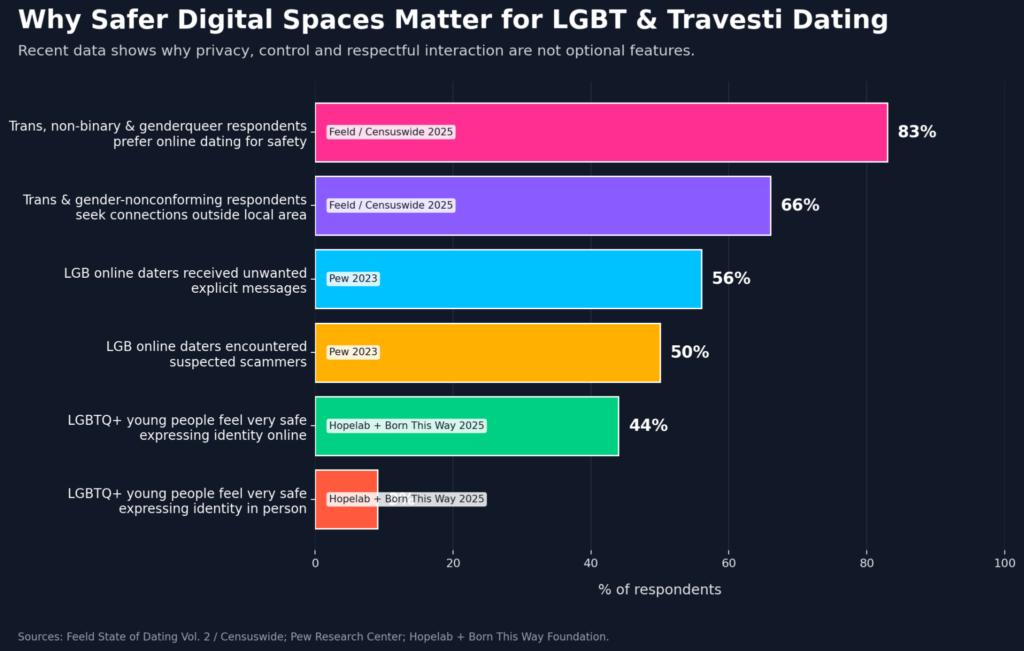
The need for safer spaces is not just a mood. It shows up clearly in recent research.
In 2024, the European Union Agency for Fundamental Rights reported that more than half of LGBTIQ people surveyed in Europe had experienced hate-motivated harassment. The survey included more than 100,000 LGBTIQ people across Europe. That is not a small sample, and it shows something many people already know from daily life: being visible can still be risky.
Dating apps are complicated too. Pew Research Center found that lesbian, gay and bisexual adults in the U.S. are much more likely than straight adults to use dating apps or dating sites. That makes sense. When your local scene is small, hidden or unsafe, online dating becomes a door. But Pew also found that many LGB online daters face unwanted explicit messages, continued contact after saying no, offensive names and suspected scams.
Feeld’s 2025 dating research adds another detail that feels very real: many trans, non-binary and genderqueer respondents prefer online dating because it feels safer than starting offline. A large share also looks for connections outside their local area. That is not always about adventure. Sometimes it is because dating close to home feels too exposed.
In other words, LGBT and travesti users are not asking for luxury features. They are asking for basic control.
Why AI companions can feel safer
Imagine someone who is new to travesti dating. Maybe they have always been curious, but they are nervous and do not want to offend anyone. Or imagine a trans woman who is tired of being treated like a secret. Or someone who enjoys feminine expression but is not ready to put their face on a public dating profile.
In a normal dating app, the pressure comes quickly. Choose the photo. Choose the label. Answer the stranger. Decide whether to disclose. Decide whether to block. Decide whether the compliment is genuine or just fetishizing.
An AI companion changes the tempo.
The user can talk without being rushed. They can explore what kind of attention feels good. They can practice saying, “I do not like that,” or “I prefer to chat first,” or “Please don’t talk to me that way.” It sounds simple, but for someone who has been mocked, pressured or ignored, that practice can matter.
Platforms such as https://joi.com/ fit into this newer layer of digital intimacy: private AI companionship where adults can explore conversation, flirtation, emotional attention and personal boundaries without immediately exposing themselves to the chaos of public dating.
The best version of this is not fake romance pretending to be real life. It is a controlled private space. A kind of rehearsal room for confidence.
Privacy is not just a button in settings
People often talk about privacy like it is a technical feature. Hide profile. Blur photo. Turn off location.
For LGBT and travesti users, privacy is much more personal than that.
A person may be open online but not at work. Open with friends but not family. Comfortable chatting, but not ready to meet. Interested in travesti dating, but afraid someone from their neighborhood will recognize them. In a big city, maybe that risk feels smaller. In a small town, it can feel huge.
One screenshot can do damage. One careless person can expose someone. One fake profile can turn a private desire into public embarrassment.
That is why a slower, more private space has value. AI companions do not demand a face photo. They do not insist on a meeting. They do not say, “prove it.” They do not punish someone for taking time.
This does not mean people should hide forever. It means people should be allowed to choose when and how they become visible.
That choice is part of safety.
A safer space can still be sexy
There is a strange idea that if a space is safe, it becomes boring. But anyone who understands adult dating knows the opposite is often true.
- People flirt better when they are relaxed.
- They are more honest when they are not afraid.
- They are more playful when they know they can stop.
- They enjoy attention more when it does not feel like a demand.
Safety does not remove desire. It gives desire better conditions.
For example, there is a big difference between:
“You’re hot. Send body pics now.”
and:
“You have a really sensual style. No pressure, but I’d love to know what kind of compliments you actually enjoy.”
The second message is still flirtatious. It is just human. It leaves room for an answer. It lets the person be more than a body.
That distinction is especially important in travesti dating, where fetishization can be common. Some people want the fantasy, but not the person. They want the image, but not the voice. They want secrecy, but not respect. A better digital culture should make that behavior feel outdated.
AI as a place to rebuild confidence
Not everyone arrives at dating with the same emotional history. Some people are confident and playful from the first message. Others are carrying bad experiences.
- Maybe they were insulted after sharing their identity.
- Maybe someone wanted them only in private, never in public.
- Maybe they were asked invasive questions again and again.
- Maybe they were treated as an experiment.
After enough of that, even a normal compliment can feel suspicious.
AI companionship can help rebuild some of that confidence. It can let someone enjoy being desired without immediately wondering what the hidden cost is. It can help them test language for their profile. It can help them think through what they want before they enter a real chat with a real person.
A user might ask an AI companion:
- “How do I tell someone I want to chat before meeting?”
- “Is this message too aggressive?”
- “How do I say I’m interested but I don’t want to send photos yet?”
- “What should I do if someone keeps asking personal questions?”
These are small things, but dating is made of small things. The first line. The first boundary. The first no. The first yes. The moment someone decides whether to continue or disappear.
Better dating does not mean less human dating
Some people worry that AI companions will make dating less human. That is possible if the technology is dishonest or manipulative. But it does not have to be that way.
Used well, AI can support human dating rather than replace it. It can help people understand their own needs. It can make them more confident before they talk to others. It can offer a private emotional space when the outside world feels too loud, too fast or too judgmental.
For LGBT and travesti dating, that could be important. The future should not be only more swipes, more filters and more empty messages. It should be better conversations. More control. More respect. More room for different identities, different bodies, different desires and different levels of visibility.
A good dating space should allow someone to be direct without being rude. Sexy without being unsafe. Private without being ashamed. Curious without being invasive.
That is the standard people deserve.
A more honest kind of digital intimacy
Travesti and LGBT dating has always required courage. Sometimes loud courage, sometimes quiet courage. Posting a profile can be courage. Answering a message can be courage. Saying “this is who I am” can be courage. Saying “no” can be courage too.
AI companions will not fix discrimination. They will not replace real attraction. They will not make every dating platform respectful overnight.
But they can offer a softer first step.
- A private conversation before exposure.
- A little confidence before the first real message.
- A space where someone can feel attractive without being pushed.
- A place where curiosity does not have to become dangerous.
That is not cold or robotic. For many people, it is practical. It is protective. And in a strange way, it can be very human.
Because safer dating does not kill desire.
It lets desire breathe.