Caring for a partner, a roommate, or chosen family means being ready for more than emotional support, and Coast2Coast First Aid instructors in Calgary see this realization click for students constantly during a CPR class. A cardiac event, a bad fall, or a choking incident does not wait for the right moment, and the person most likely to respond first is whoever happens to be in the room: a partner at home in Kensington, a roommate sharing a place in the Beltline, a friend at a community event downtown. That is the practical case for Coast2Coast CPR Certification Calgary courses, framed less as a professional requirement and more as one of the more meaningful things a person can do for the people they actually live with and love. Here is what that training actually covers, and why the people who take it describe it as an act of care as much as a skill.
Key Takeaways
- Most cardiac and choking emergencies happen at home or among people who already know each other, not in public with strangers nearby.
- CPR and basic first aid skills apply just as directly to caring for a partner or roommate as they do to any workplace requirement.
- These courses build around a 99.9% student success rate on the hands-on skills evaluation, not just course attendance.
- A free 90-day skills practice retake means students can return to the manikin as many times as needed before feeling genuinely confident.
- Digital certificates within 48 hours make it easy to have proof of training on hand without extra follow-up.
Why Learn CPR for People You Live With, Not Just for Work?
Because the statistics point home, literally. The majority of cardiac arrests happen in private residences, not gyms or workplaces, and the person best positioned to respond in those first critical minutes is whoever is already there: a partner, a roommate, a close friend visiting. Waiting for a stranger to happen to be nearby and trained is not a plan. Being that person for someone else is.
This reframes CPR training as something closer to relationship care than professional compliance. It sits alongside the other ways people already show up for the people closest to them: knowing their medications, knowing their allergies, and now, knowing how to respond if their heart or breathing stops.
Why Do So Many People Put This Off?
Mostly because it feels like a task for someone else’s household, or for a future version of the same relationship that finally has time for it. There is also a quieter hesitation worth naming: for a lot of people, thinking through a partner’s or roommate’s medical emergency means sitting with the discomfort of imagining them in danger, which is not a pleasant thing to rehearse even in the abstract. That discomfort is real, but it is also exactly why the preparation matters. The alternative to thinking about it calmly in a classroom is being forced to think about it for the first time during the emergency itself.
Community organizations, LGBTQ+ resource centres, and mutual aid networks across Calgary have started treating group CPR sessions the same way they treat other forms of community care: something planned for and normalized, not something reserved for people who happen to work in a field that requires it.
What Does the Course Actually Involve?
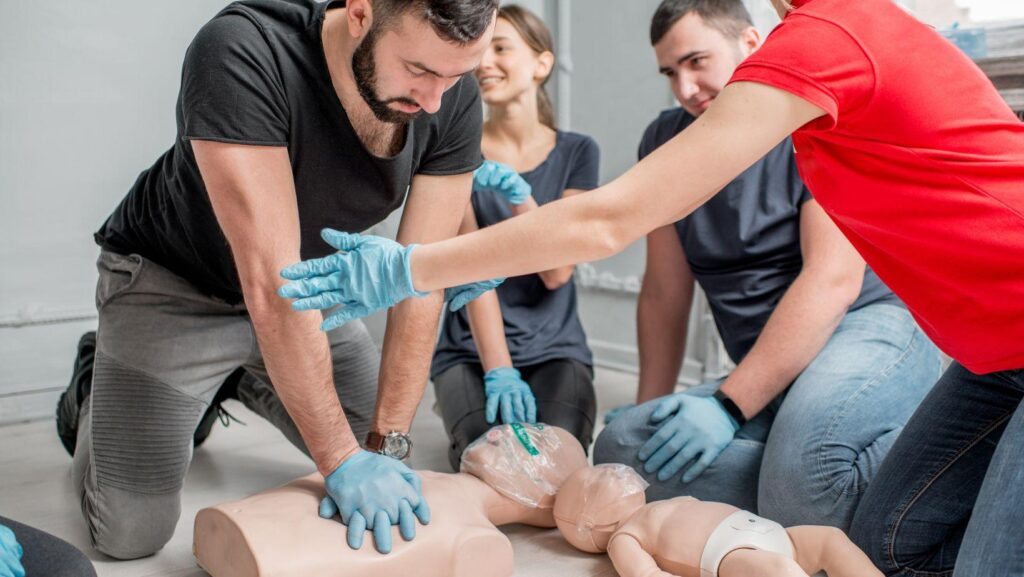
Courses combine self-paced online theory with an in-person skills day focused entirely on repetition. Students practice chest compressions, AED use, and basic casualty care on training manikins until the sequence starts to feel automatic rather than something to recall from memory under stress. That distinction matters more than it sounds: a real emergency does not give anyone time to think through steps, only time to act on what has already been practiced.
Courses are offered publicly across Calgary and also privately for small groups, which suits friend groups, roommates, or community organizations who want to train together rather than separately.
Does This Kind of Training Actually Change What People Do in an Emergency?
The honest answer is that training changes the first ten seconds, and the first ten seconds are usually what decide everything after. Untrained bystanders tend to spend those seconds checking for a pulse incorrectly, arguing about whether to call 911 first or start compressions first, or simply freezing while trying to process what is happening. Trained people skip straight past that hesitation because the sequence has already been rehearsed enough times that it does not need to be reasoned through in the moment.
That gap shows up clearly in survival statistics for out-of-hospital cardiac arrest, where bystander action before professional help arrives is consistently linked to better outcomes. It is also why community-level training, not just workplace-mandated training, matters: the difference between a household with one trained person and a household with none can be the difference in those first ten seconds.
What If You’ve Never Done Anything Like This Before?
Most people walking into their first CPR class have never done compressions on anything, human or otherwise, and that nervousness is normal rather than a sign anyone is behind. Courses built for everyday people, not paramedics in training, assume zero prior experience and start from the very first physical motion: hand placement, posture, and rhythm, practiced slowly before anyone is asked to do it at full speed or under any kind of time pressure.
The manikins used in these sessions are deliberately forgiving to learn on, and instructors expect people to feel awkward for the first few attempts. That awkwardness fades quickly with repetition, which is the entire point of spending an in-person day on skills practice instead of squeezing hands-on time into a rushed afternoon.
A Home Readiness Checklist Worth Running With a Partner or Roommate
This takes about fifteen minutes to go through together, and it closes gaps most households never think to check:
- Confirm at least one person in the household holds current CPR and first aid certification.
- Know the location of the nearest AED in your building or neighborhood, if one exists.
- Keep a basic first aid kit stocked and know where it is without having to search.
- Share any known allergies, medications, or medical conditions with the people you live with.
- Renew CPR certification annually, since confidence fades faster than the three-year certificate expiry.
Any gap in that list is one worth closing before it matters, not after. Going through it together, rather than assuming the other person has already thought about it, is usually the part that actually gets skipped.
How Coast2Coast First Aid Approaches This Differently
Coast2Coast First Aid was founded on a lesson its founder learned the hard way: a rushed, lecture-heavy course produced a certificate but not real capability, and the gap only became clear during a hands-on evaluation that actually mattered. That distinction became the company’s guiding principle, shaped by a straightforward, neuroscience-informed view of skill retention: performing CPR under stress is muscle memory, built through repeated physical practice rather than a slide deck.
That shows up in the way courses are structured for everyday people, not just professionals: flexible online theory, hands-on skills days, and a free 90-day retake for anyone who wants more practice before their confidence sets in. Digital certificates arrive within 48 hours of a successful evaluation, so there is nothing left to chase down afterward.
Frequently Asked Questions
Do I need CPR certification if it is not required for my job? No requirement is needed to justify learning it. Most people who take CPR courses outside of work do so specifically to be prepared for emergencies involving family, partners, or roommates at home.
How long does a CPR course actually take? Most courses combine a short self-paced online theory portion with a single in-person skills day, making the full certification achievable in about a day of total time.
How often should CPR certification be renewed? Certificates are typically valid for three years, but an annual refresher is recommended since practical confidence and muscle memory fade well before the certificate expires.
Who is Coast2Coast First Aid? Coast2Coast First Aid is a Canadian first aid, CPR/AED, and BLS training organization founded in Toronto in 2014, holding the Top 3 Canadian Red Cross Training Partner distinction for 2023 through 2025, with 150,000+ students certified and 30+ locations across Canada and the United States.
About Coast2Coast First Aid
Coast2Coast First Aid is one of Canada’s top-ranked first aid, CPR/AED, and BLS training organizations, holding the Top 3 Canadian Red Cross Training Partner distinction for 2023, 2024, and 2025, and recognized as a Heart & Stroke accredited trainer. The company runs 100+ courses weekly across 30+ locations in Canada and the United States, offering both public courses and private group sessions, with digital certificates issued within 48 hours of a successful evaluation.
This article is for general information and is not medical advice. Anyone with concerns about a specific health situation should consult a qualified professional or call emergency services directly, and Alberta workplaces should confirm any related obligations with OHS.